What is E-Invoicing?
E-Invoicing is not simply sending a PDF by email or using online invoicing software. Instead, it’s a method of exchanging invoices in a structured digital format directly between accounting systems. This means that, rather than exchanging files, the underlying data is sent and received so software can process it automatically.
That data is machine-readable (XML format), so it can be processed automatically. When a client receives a supplier’s E-Invoice, the information it contains is automatically captured in the right place – without anyone having to type the details into software or upload a copy to their accounting system.
E-Invoices are sent via secure networks such as Peppol, used by businesses and governments worldwide. Businesses don’t need the same accounting software as their partners, just the same E-Invoicing network.
Issuing invoices should be as simple as creating a traditional invoice, if not simpler. Once you’ve registered for Peppol, it’s then a case of enabling E-Invoicing in your accounting software, adding the relevant customer information – including their VAT number and Peppol ID – creating the invoice and sending it via Peppol. The system will validate the invoice, transmit it through the network, confirm delivery and allow you to track its status.
Traditional Invoice
A PDF sent by email- Invoice is created and exported as a PDF
- PDF is emailed to the customer
- Customer opens, saves or prints the file
- Details are retyped into the accounting system
- Typing errors are fixed by hand, queries follow
- No delivery confirmation, no way to track
E-Invoice
Structured data over Peppol- Invoice is created in your accounting software
- Software converts it to structured XML
- It travels to the customer over Peppol
- Data lands in their system – nothing is retyped
- Fewer errors, fewer disputes and rejections
- Delivery confirmed, status tracked in real time
Why E-Invoicing Matters
E-Invoicing boosts efficiency, security, and sustainability for businesses.
Time Savings
Automation will significantly reduce invoice processing time. Paper invoices will be replaced by structured, machine-readable electronic forms, making them easier to manage and archive.
Increased Accuracy
Invoice data will no longer need to be entered manually, saving time and reducing the risk of errors. This should lead to fewer disputes and rejected invoices.
Cost Savings
E-Invoicing reduces manual entry, cuts costs for creating, printing, posting and archiving, and allows accounting teams to focus on strategic tasks. Government research suggests invoicing costs could drop by 60–80%.
Financial Insight
E-Invoicing will enable better oversight of revenue, aiding budget planning. Invoices will be delivered in seconds and clearly show all relevant information. Late payments will be minimised and cash flow visibility will be improved through real-time tracking of invoice status.
Enhanced Security
E-Invoicing provides a clear data trail, making it easier to trace and validate documents and payments. It’s also much more difficult to create a fake E-Invoice on a secure network.
Greener Operations
E-Invoicing could contribute to ESG goals by significantly reducing paper waste and the energy used for printing, posting, and archiving invoices.
Business Growth
As E-Invoicing is increasingly adopted worldwide, cross-border business could become easier once the UK transitions to the system. The government has signed digital trade agreements with countries including Singapore, Australia and New Zealand, which aim to facilitate growth and collaboration in the digital economy. And because E-Invoicing solutions are scalable, SMEs can embrace growth without worrying about how they’ll handle a greater volume of invoices.
Tackling Late Payments
One of the key reasons for implementing E-Invoicing is to reduce the burden of late payments on small and medium-sized enterprises. According to a UK government consultation that concluded in 2025, more than 1.5 million businesses are affected by late payments at a cost of almost £11 billion per year. Even more worryingly, 38 UK businesses close down every day because of late payments.
Mandating E-Invoicing will play a key role in addressing this issue, with industry research showing a 20% reduction in late payments upon adoption. This equates to an annual saving of £11,300 for small firms and a 3% boost in labour productivity in finance-heavy sectors.
Reducing the VAT Gap
The positive impact of E-Invoicing on the VAT gap – the difference between the amount of tax authorities expect to receive based on economic data and the actual VAT revenue collected – is also of note.
Data from the European Commission suggests that the move to E-Invoicing across the EU is helping to reduce VAT fraud by up to €11 billion a year. The UK government also sees the transition as a way to reduce the VAT gap.
How the 4-Corner Model Works
Instead of using a centralised government portal, the UK will implement a decentralised ‘4-corner model’ for exchanging electronic documents. In this model, four parties are involved: the sender, the recipient, and their respective service providers (called ‘Access Points’). The system is expected to use the Peppol network, a widely-used open framework. Access Points are certified service providers that connect businesses to the Peppol network.
The Peppol 4-corner model has long been the foundation of E-Invoicing across Europe and beyond, ensuring interoperability between businesses through certified Peppol Access Points. These are responsible for applying Peppol protocols and standards for sending and receiving electronic documents.
Sender
The supplier creates an electronic invoice in their accounting software and sends it to their Peppol Access Point.
Sender’s Access Point
The Access Point validates the invoice, applies Peppol standards and passes it into the network.
Recipient’s Access Point
The recipient’s Access Point receives the document and forwards it on to their internal system.
Recipient
The invoice data lands in the customer’s accounting system, ready to review and pay. Delivery is confirmed back to the sender.
With E-Invoicing, the sender’s accounting software connects to the network via an access point. Invoices are created as normal, with the software handling the technical side.
Utilising the Peppol network enables the secure, automated sending and receiving of invoices without manual intervention. As it adheres to common standards, businesses can send invoices over the network worldwide without having to adapt to multiple technical specifications.
The UK Timeline for E-Invoicing
While the benefits of E-Invoicing are clear, there’s still some way to go before the system is fully introduced, and many questions remain about what implementation will look like and who will be impacted when.
- Nov 2025 Government announces that E-Invoicing will be mandated in the UK
- Jan–Mar 2026 Stakeholder consultation runs, closed in March 2026
- Autumn 2026 Full implementation roadmap published at Budget 2026
- 2027–28 Businesses and software providers prepare for the change
- April 2029 E-Invoicing becomes mandatory for B2B and B2G VAT invoices
What We Know So Far
- From 1 April 2029, E-Invoicing will be mandatory for all VAT invoices in business-to-business (B2B) and business-to-government (B2G) transactions.
- The initial focus will be on establishing the E-Invoicing infrastructure – real-time reporting to HMRC will not be included in the 2029 launch.
- The rollout is expected to be phased, with larger businesses having to make the switch first.
- The government will adopt a decentralised 4-corner E-Invoicing model, which allows businesses to exchange E-Invoices directly through their chosen software providers.
- It is expected to be based on Peppol, an international framework that ensures cross-border compatibility.
- A stakeholder consultation launched in January 2026 closes in March 2026, with a full implementation roadmap to be published at Budget 2026 in the autumn.
What’s Yet to Be Confirmed
- No details have yet been provided on the exact revenue and size thresholds for the phasing in of E-Invoicing.
- The technical standards and specific mandatory electronic formats that invoices must follow are yet to be confirmed.
- Details of any exemptions that may apply, as well as any support available to help businesses with the transition, are also unavailable.
- Penalties for non-compliance are yet to be finalised.
E-Invoicing Around the World
While the introduction of E-Invoicing represents a significant change to the UK's financial landscape, mandatory electronic invoicing is increasingly being adopted worldwide, with several countries using it successfully for years. Latin America led the way in the early 2000s.
Italy
The first European nation to make the switch, making E-Invoicing mandatory in January 2019. Italy opted for a 100% centralised approach via the government platform, SDI (Sistema di Interscambio), affecting all B2B, B2C, and B2G transactions. The country has since reported an annual increase in tax revenue of approximately €6 billion, thanks to real-time access to data, reduced administrative burdens and improved traceability.
Germany
Began a graduated rollout in 2025, with mandatory receipt of electronic invoices for all businesses in the B2B sector introduced in January 2025. This will extend to all businesses with a turnover of more than €800,000 on 1 January 2027, before all companies must send electronic invoices from January 2028.
France
France is currently in the process of making the transition, with mandatory receipt requirements for all businesses and mandatory issuance requirements for large and mid-sized companies coming into effect from September 2026. Mandatory issuance and e-reporting for all VAT-registered companies will follow from September 2027.
Poland
Made E-Invoicing mandatory for large companies with a turnover of PLN 200 million+ in February 2026.
Belgium
Began mandatory E-Invoicing in B2B for VAT-registered companies established in the country in January 2026.
Many of these countries utilise the Peppol network as their exchange system, making them some of the more than 40 countries that have integrated Peppol into their national electronic invoicing systems.
The Results Speak for Themselves
Decrease in invoice processing time since adoption, with 30% reporting a 75–100% improvement
Saved per week by small companies in the EU
Of adopters reported improved communication, collaboration and dispute resolution with customers and suppliers
Of adopters said that barriers to implementation were not as significant as expected
Source: Sage research
AccountsPortal & E-Invoicing
With preparations for mandatory E-Invoicing continuing apace, AccountsPortal is tracking requirements closely and building E-Invoicing capability into our software ahead of the deadline. By ensuring we are, and remain, ahead of this change, we will enable a seamless transition with no disruption to existing processes.
In the meantime, our existing invoicing features already give customers a head start with digital, structured, and automated workflows that let you easily track, trace, and account for all your incoming and outgoing payments in one place. This simplicity, automation and reliability will continue as the move to E-Invoicing gathers pace.
Try AccountsPortal for Free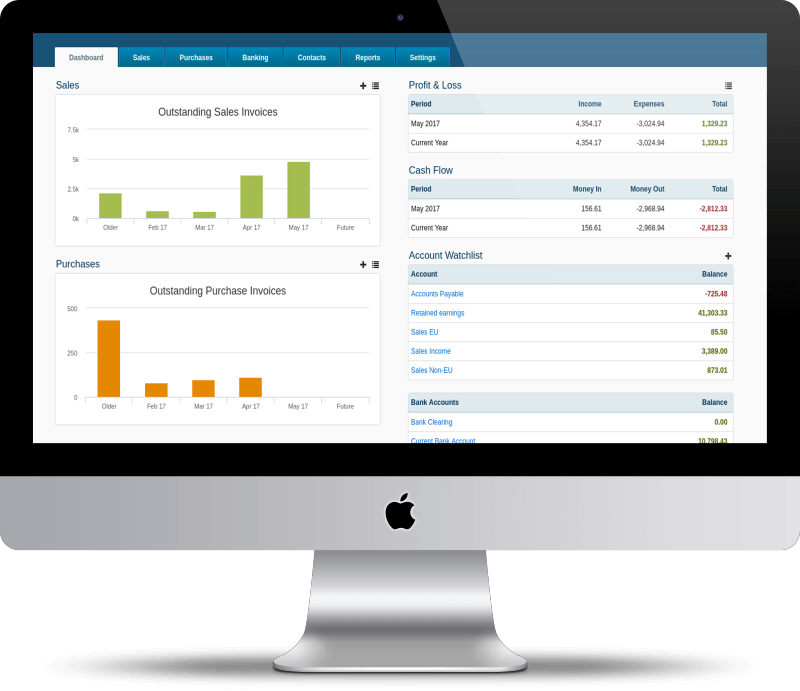
E-Invoicing FAQ
The answers to the questions we’re asked most often about the move to mandatory E-Invoicing in the UK.
Identify key partners, suppliers, and service providers, and consider where alignment may be required, as buyers and suppliers will need to connect through compliant platforms.
Make sure staff are aware of any new procedures or workflow changes well in advance of the deadline.

Get Ahead of E-Invoicing
April 2029 will arrive sooner than you think. Start with digital, structured invoicing today and the transition will be one less thing to worry about.